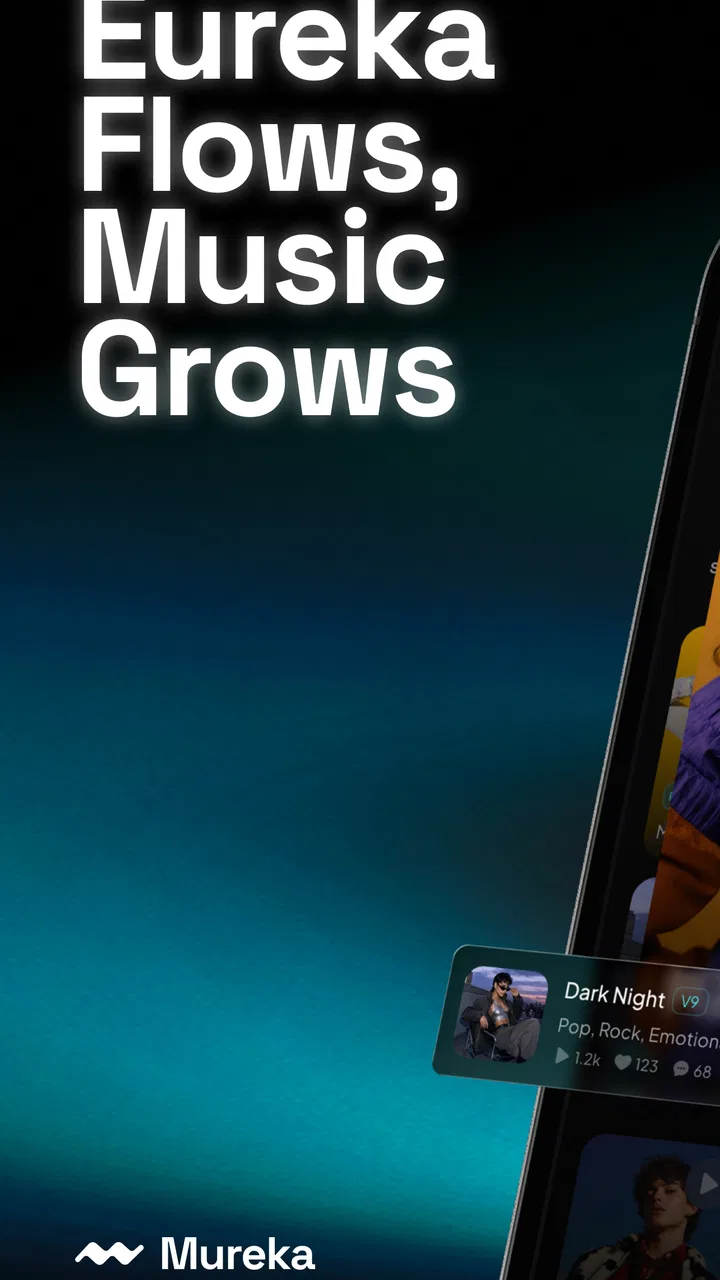
Mureka: AI Radio & Music Maker
- 4.7
- Rating
- 5.00M
- Installs
- Free
- Price

 Analysis by App-foxy
I tried Mureka as someone who wanted to turn a musical idea into a usable song without first learning a full production suite. That is the app’s strongest appeal: it brings AI music creation into a much lighter, more approachable workflow than a traditional digital audio workstation. Instead of beginning with tracks, plug-ins, routing, and technical setup, I could focus on the feeling, subject, and direction I wanted the song to have.
Mureka - AI Song&Music Maker is a free Music & Audio app from Skywork AI Pte.Ltd. It is available for users aged Everyone, supports Android 7.0 and later, and its current version is 1.22.0. The app has built a strong audience, with an average rating of 4.8 from around 123 thousand ratings and over one million installs. Those figures suggest that the idea is resonating, but they do not remove the need to decide whether an AI songwriter actually matches the way you want to work.
What I looked for before choosing an AI songwriter
My first decision criterion was control. There is a big difference between wanting a quick musical sketch and wanting to direct every chord, drum hit, vocal phrase, and mix decision. Mureka is aimed much more at the first situation. It is useful when the starting point is a concept such as “a warm acoustic song about leaving home” rather than a finished melody that must be reproduced exactly.
You May Also Like

 Blood Strike: 2.5 Anniversary
Blood Strike’s Loadouts Turn Every Drop Into a Tactical Gamble
A close look at Blood Strike’s custom loadouts: how fast access to signature weapons reshapes its battle royale rhythm, rewards preparation, and narrows the gap between fights.

 Pandora - Music & Podcasts
Pandora’s Music Is Easy to Start, but Harder to Recover
Pandora’s strength is its low-effort path from a seed to a station. Its weak spot is how much confidence it asks you to place in connection, setup, and quiet recovery.

 8 Ball Pool
 Is Built on Rivalries, Rematches, and Routine
A close look at the rivalries, rematches, shared routines, and unanswered safety questions that turn a quick pool match into a persistent mobile community.

 Samsung Music
’s Quiet Strength Is Playing What You Already Own
Its reach comes less from spectacle than from dependable access to a personal library. That simplicity is both the app’s strongest retention engine and its ceiling.

 AccuWeather: Weather Radar
AccuWeather Review: A Quick, Clear Forecast for Everyday Decisions
For everyday plans, the best forecast is the one you can understand quickly. AccuWeather makes rain timing, radar, and local conditions easy to act on, with a few trade-offs.

 Hill Climb Racing
Why Hill Climb Racing Still Turns Crashes Into One More Run
A tiny car, a bumpy hill and one more upgrade: Hill Climb Racing keeps resurfacing because its simple chaos makes every near-miss feel personal.
More From Our News Desk



The second criterion was speed. A conventional music-making app can be more suitable if I already have an instrument recording, a carefully written arrangement, or a specific production style to preserve. Mureka makes more sense when the blank page is the problem. I could begin with an idea and quickly explore possible directions instead of spending the first session building a project from empty tracks.
I also considered how much editing I expected after generation. AI-created music can be inspiring, but inspiration and final production are not the same thing. If I need detailed control over individual notes, vocal timing, drum programming, or mastering, I would judge Mureka as a starting point rather than a complete replacement for a traditional workstation.
That distinction matters for beginners. The app’s simplicity is a benefit when technical choices feel intimidating, but the same simplicity can feel restrictive once I know exactly what I want. I would choose it for ideation, casual creation, songwriting practice, social content, and quick demonstrations before choosing it for a demanding studio project.
How the first session feels
The most comfortable way to approach Mureka is to arrive with a clear brief. I get better results when I decide on the emotional direction, subject, broad genre, and intended listener before asking the app to create anything. A vague request can be fun, but a short, focused description gives me something easier to evaluate.
One useful habit is to treat the first result as a draft, not a verdict. If the song is too bright, too dramatic, too slow, or too busy, I can identify the single biggest problem and revise the direction around that issue. Trying to correct every weakness at once makes it harder to understand what changed. I prefer making one meaningful adjustment, listening again, and keeping notes about which wording produced the most useful result.
This approach also helps with lyrics. Rather than asking for a complete song about a broad subject, I would define the point of view and the emotional turn. A song about missing a friend can be sentimental, grateful, regretful, or hopeful. Giving the app that distinction produces a more purposeful starting point than simply naming the topic.
Where Mureka is especially convincing
The app wins when the goal is to move from imagination to a listenable example quickly. I can use it to test whether a chorus idea feels uplifting, whether a concept suits a particular style, or whether a lyric has enough emotional shape to support a full song. That is valuable even if I later rebuild the track elsewhere.
It is also a good fit for people who do not play an instrument. A traditional songwriting workflow often assumes access to a keyboard, guitar, beat-making tools, or at least enough theory to sketch harmony. Mureka lowers that entry barrier. I can think in terms of mood and story first, which makes the process less intimidating for a beginner.
Another strength is its usefulness for comparison. I can explore several interpretations of the same idea and notice which arrangement feels closest to the intended message. This is more productive than becoming attached to the first output. In practice, the app works best when I use it as a creative conversation: I provide direction, inspect the result, and refine my brief.
The most important mindset shift is to judge each generation as material to shape, not as an automatically finished record. That expectation keeps the experience enjoyable and avoids the disappointment that comes from expecting a single prompt to replace a producer, songwriter, vocalist, and mixing engineer at once.
A practical everyday workflow
Imagine I want to make a short birthday song for a friend. I would begin by describing the friend’s personality, the relationship, the mood I want, and whether the result should feel playful, sincere, or nostalgic. I would avoid including private details that do not need to appear in the lyrics. After listening, I would check whether the words sound natural, whether the emotional tone feels appropriate, and whether the song is memorable rather than merely polished.
If the first attempt sounds too generic, I would add concrete but non-sensitive details: a shared habit, a familiar place, or the kind of moment the song should recall. If it becomes too literal, I would remove some explanation and ask for more imagery. This is one of the less obvious lessons of AI songwriting: better direction often comes from editing the brief, not from demanding that the app “make it better.”
For a creator making background music for a video, I would work in the opposite direction. I would define what the music must leave space for, such as spoken narration, and describe the energy without asking for an overly dominant lead. I would then compare the result against the video rather than judging the audio in isolation. A track that sounds impressive alone may compete with speech, while a simpler arrangement may work better in context.
Where traditional alternatives still fit better
Mureka is not the natural choice for someone who wants hands-on production from the first note. A digital audio workstation remains better for recording an instrument, arranging multiple takes, editing timing, shaping individual sounds, and controlling a mix in detail. Those tools require more patience, but they reward precise decisions that an AI-first workflow may not expose.
A loop-based music app may also be preferable when I want to build a track manually from repeatable parts. That kind of workflow gives me direct control over when a beat enters, how long a section lasts, and how the arrangement develops. Mureka is faster for generating a complete idea, but manual construction can be more predictable when structure matters more than surprise.
For a singer-songwriter with a fixed melody, the better alternative may be a recording app or an instrument-based tool. Mureka is most comfortable when the system can interpret an idea, whereas a recording workflow preserves the exact performance I already have. If the emotional value lies in my own voice, guitar playing, or piano phrasing, I would not want an AI-generated result to replace that core performance.
There is also a creative trade-off. AI generation can expose me to combinations I would not have written alone, but it can also lead me toward familiar patterns. A musician developing a distinctive artistic identity should use the app as a sketchbook and keep making personal decisions outside it. The more important originality and authorship become, the less sensible it is to accept the first convenient output without substantial human revision.
Limitations I noticed in the decision process
The main friction is the gap between a verbal intention and an exact musical result. I may know that I want a chorus to feel intimate but still memorable, yet that instruction leaves plenty of room for interpretation. When the result misses the emotional balance, I have to become better at describing what I mean. That learning curve is gentler than mastering a full workstation, but it is still real.
Consistency is another consideration. If I am building several songs for a single project, I would listen carefully for whether the results feel like they belong together. A collection can become uneven when each generation follows a different interpretation of voice, energy, or arrangement. I would create a clear style brief for the project and use it repeatedly, then select the most compatible results rather than keeping everything.
I would also avoid treating generated lyrics as automatically ready for personal use. I always read them closely for awkward wording, clichés, unintended meanings, and details that do not fit the intended audience. A song can sound convincing while still telling the wrong story. Human review is especially important for gifts, public posts, and anything connected to a real person.
The free entry point makes experimentation easy, but in-app purchases range from $0.99 to $299.99 per item. That is a wide range, so I would explore the free experience first and decide what I actually need before spending money. I would not buy simply because a generation is exciting. I would first ask whether the app has become part of a repeatable workflow for me.
What switching to Mureka really involves
Moving from a conventional music app to Mureka is not just changing interfaces. It means changing the order of creative decisions. In a workstation, I might choose a tempo, create a chord progression, record a melody, and arrange sections. Here, I begin with a description and evaluate a larger musical result. That can save time at the idea stage, but it may also make me miss the tactile satisfaction of building a song piece by piece.
The cost of switching is lowest for beginners because there may be no established project system to abandon. It is also low for creators who want quick drafts alongside their existing tools. I can use Mureka to test concepts, then move to another app when I need detailed editing. The cost is higher for experienced producers who already have templates, instruments, sample libraries, and a precise way of working.
Before committing, I would run a small personal test: make one song for a real purpose, revise the direction at least once, and see whether the result saves time or creates extra cleanup. I would also check whether the output suits the intended audience and whether I am comfortable with the level of control. This test is more informative than judging the app from a single impressive demo.
For families and younger users, the Everyone rating makes the app approachable from an age-classification standpoint, but I would still encourage supervision around sharing, personal information, and spending. The age label does not replace ordinary digital judgment. A child experimenting with music may need help understanding what should remain private and what is appropriate to publish.
Who should download it
I recommend Mureka to curious beginners, lyric writers who want to hear ideas, content creators who need quick musical drafts, and casual users who want to make songs for personal moments. It is particularly appealing if the hardest part of music creation is getting started. The app gives an idea somewhere to go without requiring a room full of equipment or a long technical tutorial.
I also see value for experienced musicians during the early stage of a project. A generated direction can challenge a familiar habit or reveal an arrangement that I would not have considered. I would keep my own judgment in charge, though. The tool is most useful when it expands the number of possibilities, not when it decides the artistic identity of the final work.
I would skip it if my priority is exact control, faithful recording, detailed mixing, or a fully manual composition process. I would also hesitate if I dislike revising AI output or if I need every musical choice to come directly from my own performance. In those cases, a recording app, instrument tool, or full digital audio workstation is likely to feel more honest and efficient.
My recommendation after using it
Mureka is best understood as an accessible AI songwriting companion rather than a complete studio. Its free price makes it easy to try, and its focus on turning descriptions into songs gives beginners a clear way into music creation. The strong 4.8 average and audience of more than one million installs reflect its appeal, but my recommendation is based more on how well its workflow matches a particular goal than on popularity.
I would download it when I need a fast musical sketch, a playful experiment, a personal gift, or a way to test a song concept before investing more time. I would keep a traditional music tool nearby for recording, precise arrangement, and final production. Used together, the two approaches complement each other: Mureka helps me escape the blank page, while manual tools give me the control needed to finish with intention.
My final advice is to start with one specific project and a modest expectation. Describe the feeling clearly, listen critically, revise the weakest part, and save only the results that genuinely serve the purpose. If that process feels energizing, the app may become a regular part of your creative routine. If you find yourself wishing you could edit every detail immediately, that is a useful answer too: you probably need a more hands-on music-making alternative.
FAQs for Mureka: AI Radio & Music Maker
01What exactly is Mureka - AI Song&Music Maker?
Mureka - AI Song&Music Maker is an innovative app that allows users to create music using artificial intelligence. It provides tools for composing, arranging, and producing songs with ease, making it accessible for both beginners and seasoned musicians. The app offers various features to enhance creativity and streamline the music-making process.
02Is Mureka suitable for beginners with no musical background?
Yes, Mureka is designed to be user-friendly and accessible to beginners. The app includes tutorials and guided assistance to help users without a musical background start creating music. Its intuitive interface and AI-powered features allow anyone to experiment with music production and develop their skills over time.
03What types of music can I create with Mureka?
Mureka supports a wide variety of music genres, including pop, rock, electronic, jazz, and more. The app’s AI capabilities help generate music that fits the style you prefer, and you can further customize your compositions with different instruments, beats, and effects to suit your creative vision.
04Are there any in-app purchases or subscription fees?
Mureka offers a free version with basic features, but also provides in-app purchases and subscription options for premium features. These may include advanced tools, additional sound packs, and exclusive AI models. Users can choose to upgrade based on their needs and level of engagement with the app.
05Can I export and share my music created on Mureka?
Yes, Mureka allows you to export your music in various formats, making it easy to share your creations on social media platforms, or with friends and collaborators. The app ensures high-quality audio output, so your compositions maintain their integrity and sound professional when shared or published.
Pros
- Intuitive interface for easy music creation.
- Wide range of AI-generated music templates.
- Supports multiple audio formats for export.
- In-app tutorials for beginners.
- Regular updates with new features.
Cons
- Limited free version functionalities.
- Requires internet for some features.
- Occasional lag on older devices.
- In-app purchases can be costly.
- Advanced features need more documentation.

Mureka: AI Radio & Music Maker
Gallery